Food, Wine & Drinks









“There is no love sincerer than the love of food”
Said George Bernard Shaw, and let us also add that there’s arguably no better way to explore a culture than to eat voraciously while traveling.
By a region’s literature and architecture you understand its history; by its art and music you understand its self-image. It is by its food, though, that you understand its true, unchanging character. The most communal of the arts, gastronomy is both visual and physical, scholarly and emotional.
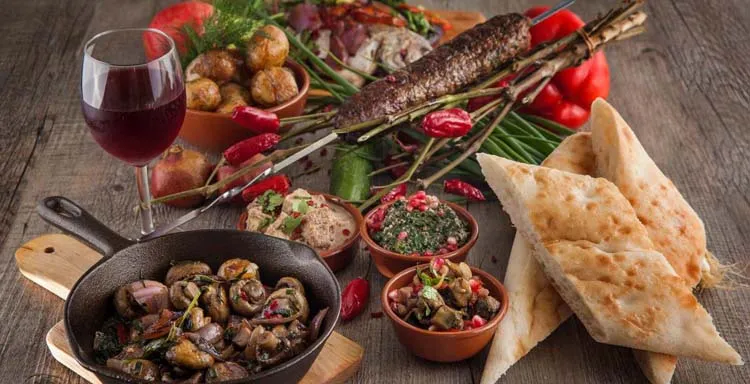
The Georgian cuisine is unique to the country, but also carries some influences from other European and nearby Middle Eastern culinary traditions. Each historical province of Georgia has its own distinct culinary tradition, with variations such as Megrelian, Kakhetian, and Imeretian cuisines. Heavy on meat dishes, the Georgian cuisine also offers a variety of vegetarian dishes.
Georgian cuisine is the result of the rich interplay of culinary ideas carried along the trade routes by merchants and travelers alike.
The greatest culinary divide is between the western and eastern region. In the west, there is a greater emphasis on vegetarian food, predominantly prepared with walnuts. Herbs and spices, especially tarragon, basil, coriander, feuille Grec, and pepper make western Georgian food hot and spicy.
Cheese usually is made from cow’s milk and is eaten with either corn bread or a corn and flour porridge. Khachapuri, a kind of cheese pizza, is common.
In the eastern area, the food is heavier, with more of an accent on mutton and pork. Wheat bread is preferred to corn, and sheep’s cheese from Tusheti is popular. Among people in the mountains, the most popular food is Khinkali, a cooked meat dumpling that usually is accompanied by beer. The most popular vegetables are tomatoes, potatoes, radishes, pumpkins, eggplant, beans, cucumbers, and cabbage. The most popular sauce, Tkemali, is made of wild plums; other sauces are based on walnuts with spices, or pomegranate juice. Wine is drunk everywhere, and stronger alcoholic beverages include Chacha (Georgian vodka), which is made of grapes and sometimes other fruit. Fish, especially trout, is eaten universally. A wide variety of locally grown fruit is supplemented by wild and cultured berries, watermelons and other melons. Dried fruit and nuts covered with a mixture of grape juice and wheat or corn flour are eaten in the winter. Jams are prepared from fruit, unripe walnuts, watermelon, eggplant, and green tomatoes.
You may try delicious Georgian food and different Georgian drinks from lemonade to Chacha in various cafes and restaurants. However, one of the best ways to experience and understand Georgian traditions of eating, drinking and enjoying life is Supra, the Georgian table – when a huge assortment of dishes are prepared, always accompanied by large amounts of wine, and that can last for hours. In a Georgian feast, the role of the tamada (toastmaster) is an important and honored position.
It shouldn’t always have a festive reason: every day can be festive in Georgia. Gathering with friends and family is very important here. If the guests are attending supra, it is even merrier. So if you are invited, don’t be shy: try all the dishes (it’s a big pleasure for the hosts if their guests are full and happy), join the toast-master, take wine with the others and say some warm words too.
Most Popular Georgian Dishes
Khachapuri
Khachapuri Is a traditional Georgian dish of cheese-filled bread. The bread is leavened and allowed to rise, and is shaped in various ways. It is Georgia’s national dish. According to a 2009 survey, 88% of Georgians prefer khachapuri to pizza.
There are several distinctive types of khachapur from different regions of Georgia:
Imeretian (Imeruli) khachapuri, which is circular and the most common type.
Adjarian (Acharuli/Adjaruli) khachapuri, in which the dough is formed into an open boat shape and the hot pie is topped with a raw egg and a pat of butter before serving.
Mengrelian (Megruli) khachapuri, similar to Imeretian but with more cheese added on top.
Achma, from Abkhazia, which has multiple layers and looks more like a sauceless lasagna.
Khinkali
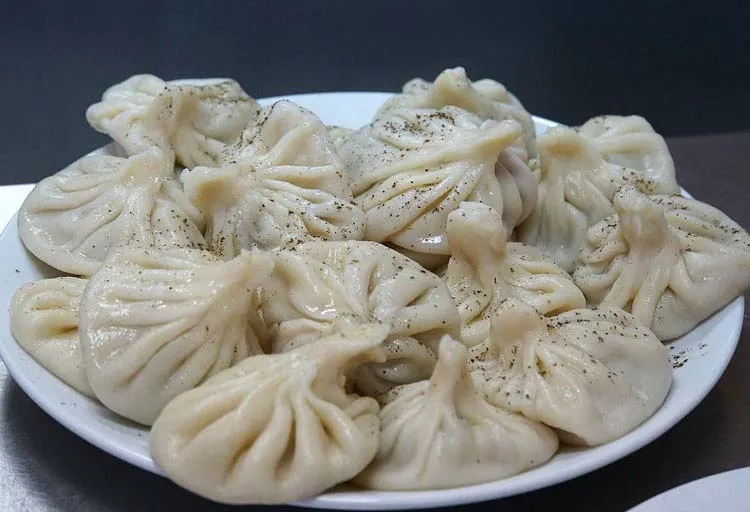
Khinkali is a Georgian dumpling,which originated in the Georgian mountain regions of Pshavi, Mtiuleti and Khevsureti.Varieties of khinkali spread from there across different parts of the Caucasus.The fillings of khinkali vary with the area. The original recipe, the so-called khevsuruli, consisted of only minced meat (lamb or beef and pork mixed), onions, chili pepper, salt and cumin. However, the modern recipe used mostly especially in Georgian urban areas, the so-called kalakuri, uses herbs like parsley and cilantro (also called coriander).
Khinkali is eaten plain, or with ground black pepper. The meat filling is uncooked when the khinkali is assembled, so, when it is cooked, the juices of the meat are trapped inside the dumpling.
The khinkali is typically eaten first by sucking the juices while taking the first bite, in order to prevent the dumpling from bursting. The top, where the pleats meet, is tough, and is not supposed to be eaten, but discarded to the plate so that those eating can count how many they have consumed.
There is a widespread etiquette in Georgia to use only one’s bare hands while consuming these dumplings.
(Photo credit: Travel Blog Venturists)
Recipe
Pkhali
Mtsvadi (BBQ)
Aka barbeque or Shashlik is a dish of skewered and grilled cubes of meat popular in many countries and in Georgia especially.
Mtsvadi is a special dish for Georgians, often the highlight of a traditional Georgian supra (or feast). It is traditionally cooked outdoors over coal and grape vines, and usually by men.
Chakapuli
Is a Georgian stew. It is considered to be one of the most popular dishes in Georgia.
It is made from lamb chops or veal, onions, tarragon leaves, cherry plums or tkemali (cherry plum sauce), dry white wine, mixed fresh herbs (parsley, mint, dill, cilantro), garlic and salt. It is popular in the spring when the plums are unripe.
Shkmeruli
Shkmeruli is a chicken dish from the Racha region of Georgia. A young chicken is usually used for this recipe and is cooked in milk and garlic. Sour cream can be used instead of milk.
Georgian Cheese
The Georgian tradition of cheese making counts more than 80 centuries.Georgia is in the top ten of “cheese” countries and makes about 250 kinds of this product. There are 80 thousand tons of cheese produced in the country annually, and 80% of all are popular cheese sulguni and Imeretian. These particular kinds are often used in Georgian dishes, including khachapuri. The most popular Georgian cheese types are:
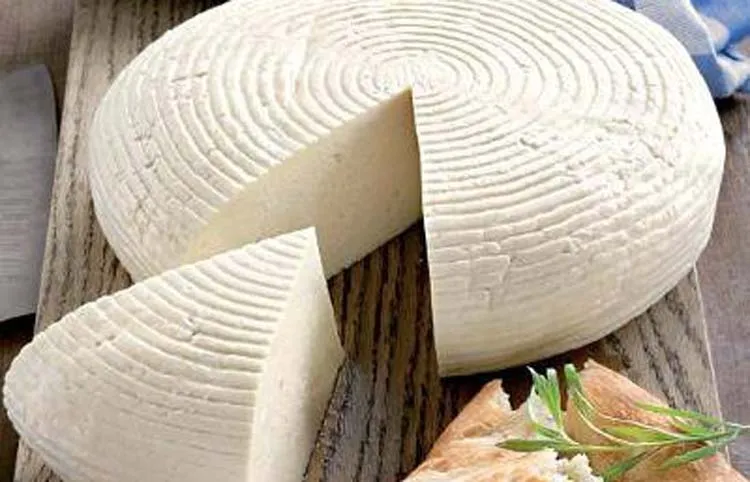
Imeruli – comes from western Georgia, Imereti Region. Is young lightly salted cow milk cheese, prepared from the fresh, not boiled milk that preserves its wholesome features.
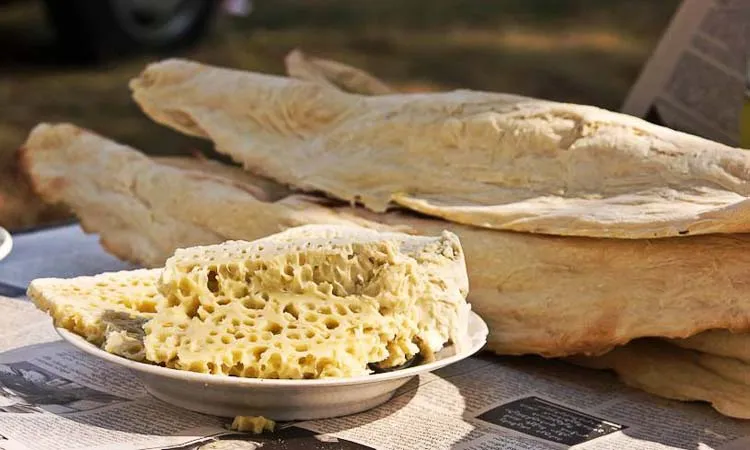
Sulguni – comes from western Georgia, Samegrelo-Zemo Svaneti Regions. This type of cheese is soft, has a sour, moderately salty flavor, a dimpled texture, and an elastic consistency. It is noteworthy that Sulguni is often compared to Italian Mozzarella, due to its texture and taste. It’s made from cow’s or Buffalo’s milk. This cheese also has a smoked variety.
Guda – mountainous regions, Tusheti Guda is the sheep milk cheese, prepared almost by the same technology as Imeretian. Further, it is stored in a sheep’s skin for 20 days, which is sometimes buried in the ground, after which the cheese obtains a specific flavor.
Ghomi & Elarji
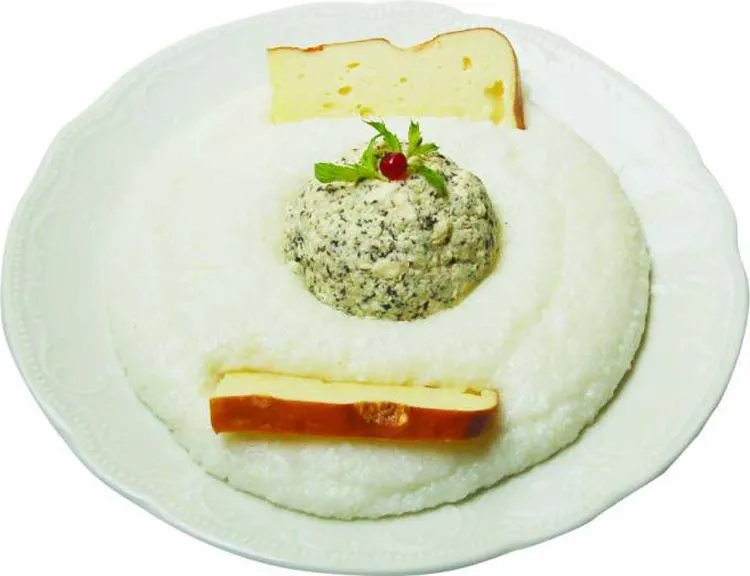
Ghomi is a traditional dish from the Samegrelo region of Georgia. It is cooked from cornmeal and corn flour and often serves as bread for western Georgians. Usually it is consumed with cheese. Elargi is ghomi with cheese already added, melted and mixed in it.
Mchadi
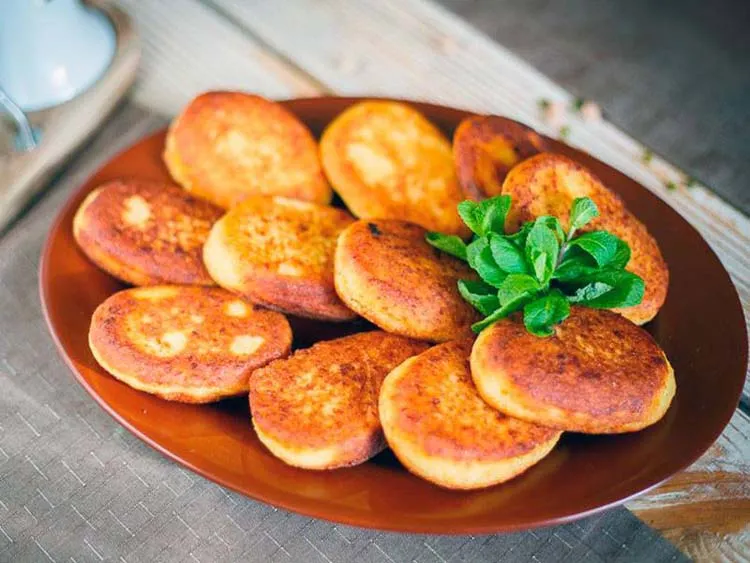
Is traditional Georgian corn bread, usually eaten hot with any kind of Georgian cheese or beans.
Tkemali
is the Georgian sour plum sauce made of cherry plums. Tkemali is made from both red and green varieties of plum. The flavor of the sauce varies, but generally tends to be pungently tart. To lower the tartness level, occasionally sweeter types of plums are added during preparation. Traditionally the following ingredients are used besides plum: garlic, pennyroyal, coriander, dill, chili pepper and salt.
Tkemali is used for fried or grilled meat, poultry and potato dishes, and has a place in Georgian cuisine similar to the one ketchup has. It can be made at home, but is also mass-produced by several Georgian and Russian companies.
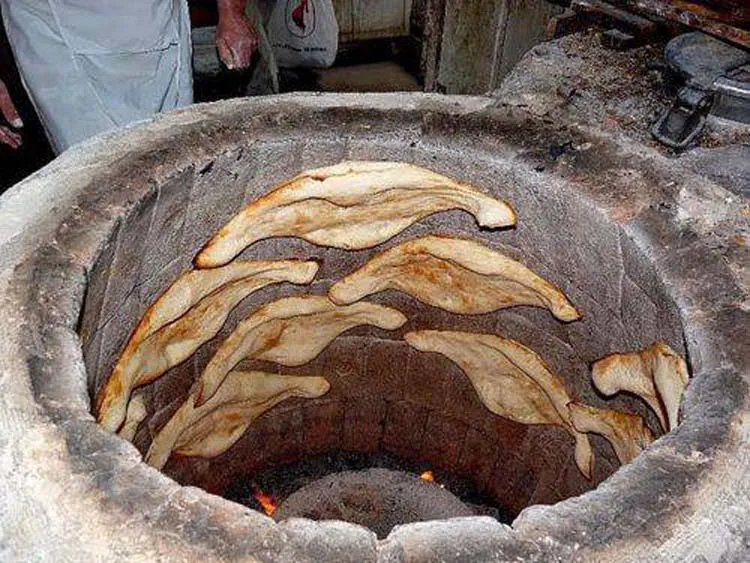
Georgian Bread Shoti
Is a type of traditional Georgian bread, made of white flour and shaped like a canoe. Shoti baked in a specific bakery called tone (deep circular clay oven).
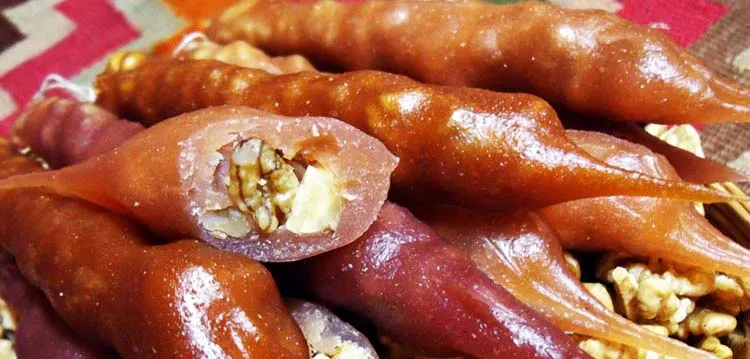
Churchkhela
It is a traditional Georgian candle-shaped candy. The main ingredients are grape must, nuts and flour. Almonds, walnuts, hazel nuts and sometimes raisins are threaded onto a string, dipped in thickened grape juice or fruit juices and dried in the shape of a sausage.
We just found a great article by our favorite Trekking in Caucasus website about most popular Georgian dishes:
Georgian Wine
Georgia finally bullet proof confirmed to be the cradle of wine!
“Scientists say 8,000-year-old pottery fragments have revealed the earliest evidence of grape wine-making” says BBC news.
See the full article here
Article from National Geographic magazine:
Oldest Evidence of Winemaking Discovered at 8,000-Year-Old Village
Article from SanFrancisco Chronicle:
Yes, Georgian wine is worth the hype and yes, you should be drinking it
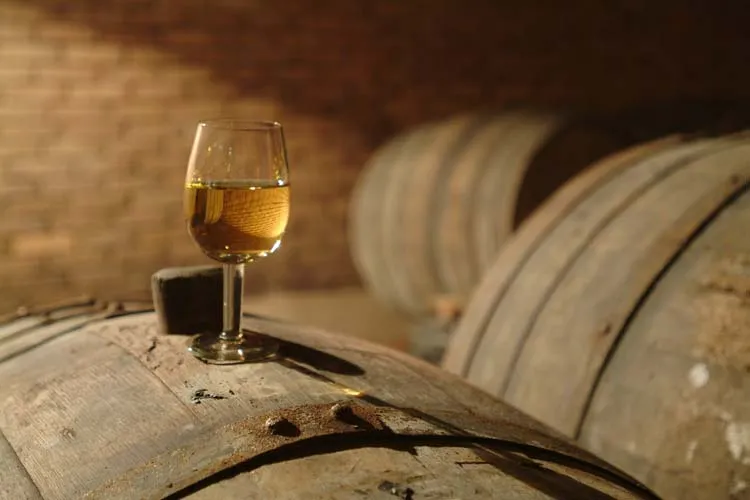
Georgia is one of the oldest wine producing regions of the world. The fertile valleys of the South Caucasus, which Georgia straddles, are believed by many archaeologists to be the source of the world’s first cultivated grapevines and neolithic wine production, over 8,000 years ago. Man discovered art of winemaking in Georgia 8,000 years ago. Due to the many millennia of wine in Georgian history, the traditions of its viticulture are entwined and inseparable with the country’s national identity.
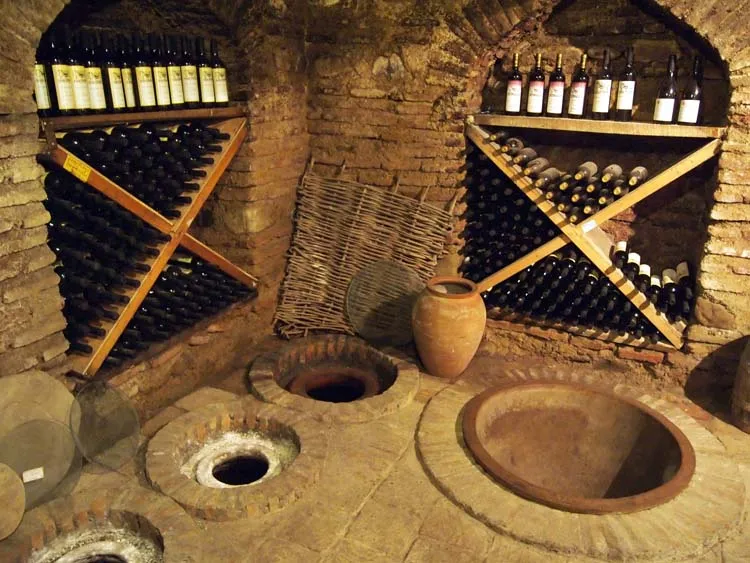
It has been archaeologically proven that the roots of Georgian viticulture are between 9000 and 7000 BC, when peoples of South Caucasus discovered that wild grape juice turned into wine when it was left buried through the winter in a shallow pit. This knowledge was nourished by experience, and from 4000 BC Georgians were cultivating grapes and burying clay vessels, kvevris, in which to store their wine ready for serving at perfect ground temperature. When filled with the fermented juice of the harvest, the kvevris are topped with a wooden lid and then covered and sealed with earth. Some may remain entombed for up to 50 years.
Georgian method of winemaking is principally different from European methods. In europe wine is separated from Grape leftovers which makes European wine lighter. In Georgia grape juice is left with grape leftovers for some time which gives the wine special strength and aroma (tanin).
Up to 500 grape sorts are cultivated in Georgia. Here one can find ancient grape sorts which do not exist in any other region of the world.
Below you we have listed most popular Georgian wines.
Red Wines
White Wines
Georgian Beer & Chacha
Beer
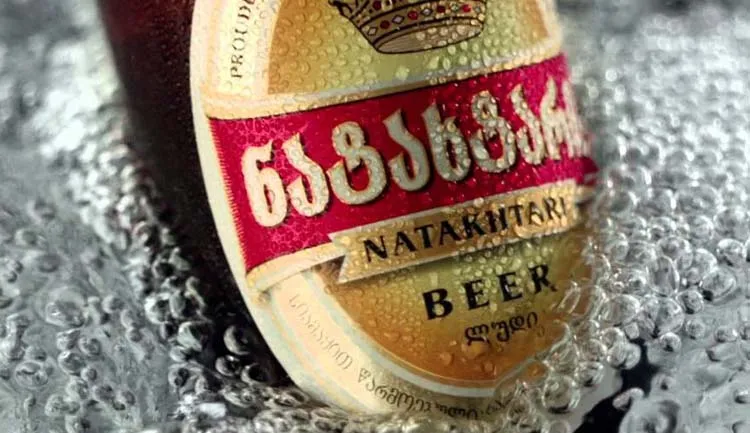
Georgia produces its own beer – most popular and established brands are: Natakhtari, ArgoKazbegi, Argo (not so goof) Shavi Lomi, Taati (good)
Like in many other countries beer is one of the most popular alcoholic drinks in Georgia. Tradition of beer making counts many centuries and was initiated in mountainous regions where wine and viniculture was not possible due to climatic restrictions. Since middle ages (and may be earlier) Georgians brewed beer on all main celebrations and it was inseparable part of traditional supra (a feast when people gather around the table to eat and drink and celebrate which lasts for many hours and is always led by a tamada (toast master) – a most honored person).
In modern Georgia you can try homemade beer if you go to mountains like Tusheti or Khevsureti on a special celebration day.
Chacha
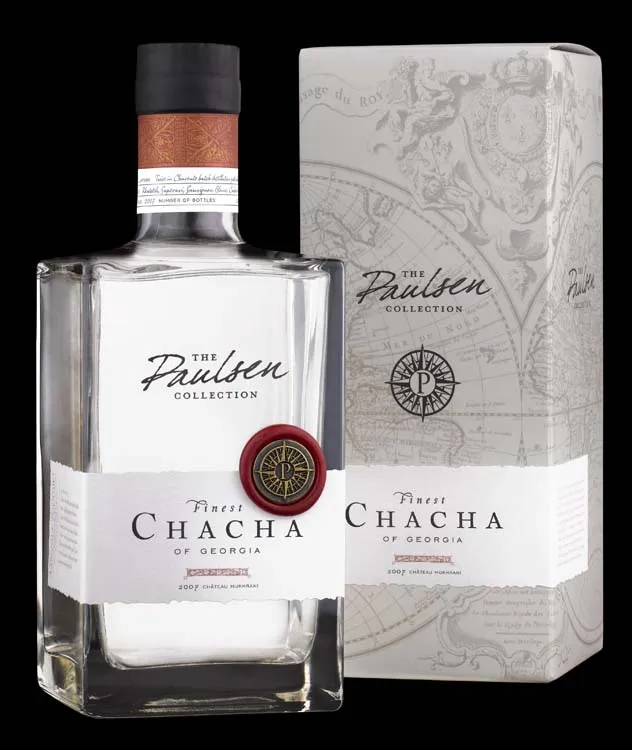
Georgian Vodka is called Chacha.
A clear and strong drink (ranging between 40% alcohol for commercially produce to 65% for home brew), which is sometimes called “vine vodka”, “grapevodka”, or “Georgian vodka/grappa”. It is made of grape pomace (grape residue left after making wine). The term chacha is used in Georgia to refer to grape distillate. It may be also produced from unripe or wild grapes. Other common fruits or herbs used are figs, tangerines, oranges, mulberries or tarragon.
Traditionally only a homebrewed drink of Georgians, it is today commonly produced by professional distillers and most wineries who include it in their product range.
Many Georgians claim chacha has medicinal properties and is suggested as a remedy for a number of ailments, including ear blockages and indigestion. Also, it is said to cure stomachaches by applying it to the abdomen. It is also said to cure acne by applying to the face.
Lemonade, Water & Mineral Waters
Georgia is a country rich in mineral water springs. While walking in mountains you will frequently encounter natural springs with naturally carbonated and mineralized water which both tastes wonderful and is very good for your health.
Due to rich natural resources mineral water production is a developed industry in the country. There are many mineral water brands which are very popular in Georgia and outside (Especially in post soviet countries). Here we describe main brands:
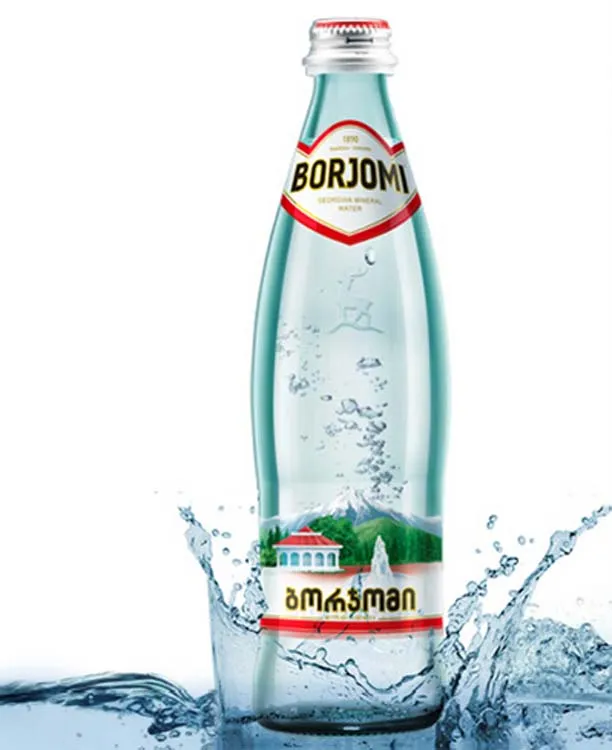
Borjomi
Borjomi is a brand of naturally carbonated mineral water from springs in the Borjomi Gorge of central Georgia. The artesian springs in the valley are fed by water that filters from glaciers covering the peaks of the Bakuriani mountains at altitudes of up to 2,300 m. The water rises to the surface without pumping and is transported by pipes to two bottling plants in the town of Borjomi.
The Borjomi springs were discovered by the Imperial Russian military in the 1820s.
Borjomi is exported to over 40 countries. Since 1995, Borjomi has been trademarked and produced by the Georgian Glass and Mineral Water Company (GG&MW). The use of Borjomi water has been suggested by the Georgian and Russian researchers for complex treatment of several digestive diseases and diabetes mellitus.
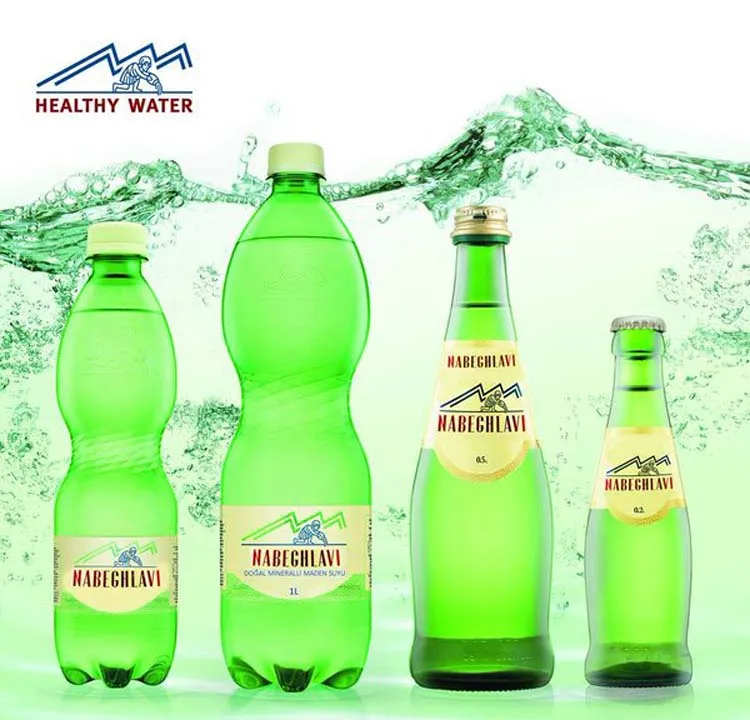
Nabeghlavi
“Healthy Water” produces famous mineral water “Nabeghlavi” and spring water “Bakhmaro.” The company was established in 1997 by Georgian and Swiss partners and by now is a leader of the local mineral water market.
The new-found company’s prime goal was to restore long-time tradition of bottling Nabeghlavi mineral water and it was successfully gained. Thus, the story of establishing “Healthy Water” company leads us back to the history of the mineral water Nabeghlavi.
The source of mineral water is located on the territory of health resort Nabeghlavi, in Western Georgia, hence the name of the water.
According to an old story, local inhabitants of the region noticed that buffalos were especially attracted to one of the water sources; the very same source later turned out to have special taste and curative properties.
Fundamental exploration of the mineral water deposit was conducted during the first half of the 20th century by famous Georgian and foreign researchers.
Initial study of the chemical composition of the water was performed in 1921 by Latvian scientist Robert Kuptsis, who spent most of his life in Georgia. Later hydro-geological research was led by famous Georgian and other Soviet scientists during the 1930’s.
Within this period, chemical properties of the water were scientifically developed and the water was stated to have hydrocarbonate calcium-sodium composition as well as carbon dioxide.
Bottling of Nabeghlavi mineral water was initiated in 1958, following the establishment of a health resort in ecologically pure environment of village Nabeghlavi that in turn was determined by revealing the water’s unique curative properties. By that time water production output and distribution area was considerably small.
“Nabeghlavi” production was taken over by JSC Healthy Water from 1998. Soon it became well-known throughout Georgia, gained appreciation of the Georgian consumers and gradually the leading position on the market.
Others brands are: Sairme, Likani, Mitarbi
Georgian Lemonade Laghidze
Laghidze Is a popular Georgian soft drink based on soda and a variety of natural syrups. It has been traditionally mixed in a glass from a soda fountain, but it is also available as a bottled soft drink in a range of flavors. Some American food writers liken it to egg cream, but the authentic Georgian drink includes neither milk nor chocolate syrup.
Lagidze water is named after Mitrofan Lagidze, a pharmacist’s apprentice in Kutaisi, Georgia, who in 1887 explored the idea of using natural syrups instead of imported flavored essences in making lemonades. In 1900, the Lagidze Brothers plant in Kutaisi began blending unique proprietary flavors from herbs and fruits. Today, Lagidze waters are produced in a wide range of natural flavors.
Water
Tap water in most areas of Georgia is good for drinking. Although newcomers are advised to get used to tap water and in the beginning consume boiled or bottled water.